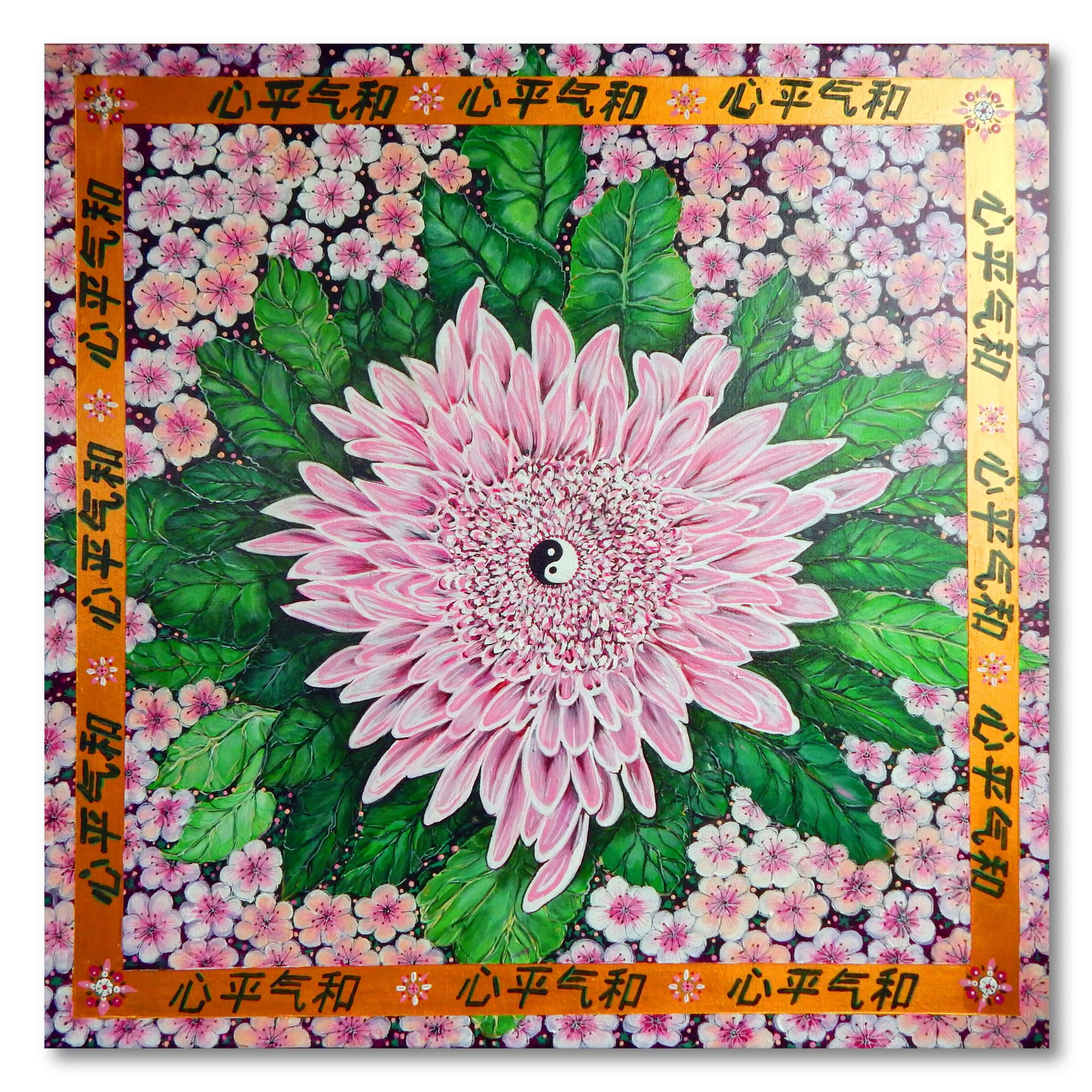
"Regard your neighbors gain as your own gain, and your neighbour’s loss as your own loss" Lao Tse, Treatise on the Response of the Tao
Flower: Pink Chrysanthemum
Sacred Symbol: Ying Yang
Mantra/Prayer: Idiom (Tranquil and Even-Tempered)
Flower:
In Taoist symbolism, the four seasons are denoted by the white
plum blossom of winter, the peony of spring, the lotus of summer, and the
chrysanthemum of autumn. Chrysanthemums, known as “ju” in Chinese, are revered for their vibrant
colours and intricate petal formations, symbolizing longevity, autumnal
beauty, and nobility A renowned Chinese poet and politician, Tao Yuanming (365-427 BCE),
who was heavily influenced by the teachings of Taoism, Confucianism
and Buddhism, wrote a poem about how he tried to live as a hermit: “I
pluck chrysanthemums under the eastern hedge, And gaze afar towards the
southern mountains” . Since then, the chrysanthemum has also been regarded as the symbol of
the hermit.
Sacred Symbol:
The sacred symbol in the middle of the painting is the
‘Ying Yang’, a circle made up of black and white swirls, each containing a
spot of the other. ‘Yin and Yang’ is a concept that originated in Chinese
philosophy, describing an opposite but interconnected, self-perpetuating
cycle. It consists of complementary and at the same time opposing forces
(such as night and day, hot and cold, feminine and masculine etc.) that
interact to form a dynamic system in which the whole is greater than the
assembled parts and the parts are important for cohesion of the whole. ‘Yin and Yang’ implies there is duality to everything but not as a conflict
between two rivals. Instead, there is balance in their contrast. In Taoist metaphysics, distinctions between good and bad, along with
other dichotomous moral judgments, are perceptual, not substantial.
Good things are constantly being born out of the seemingly bad, and vice
versa.
Mantra/Prayer:
In Taoism, the phrase Xin Ping Qi He, is often used
in conjunction with controlled breathing during meditation. Directly
translating to ‘Heart, Even - Qi, Harmony’, it means ‘a calm and level heart
brings us closer to harmony with the Qi, the vital life source’.