“What is hateful to you, do not do to your neighbour.
This is the whole Torah; all the rest is commentary” Hillel, Talmud, Shabbath 31a
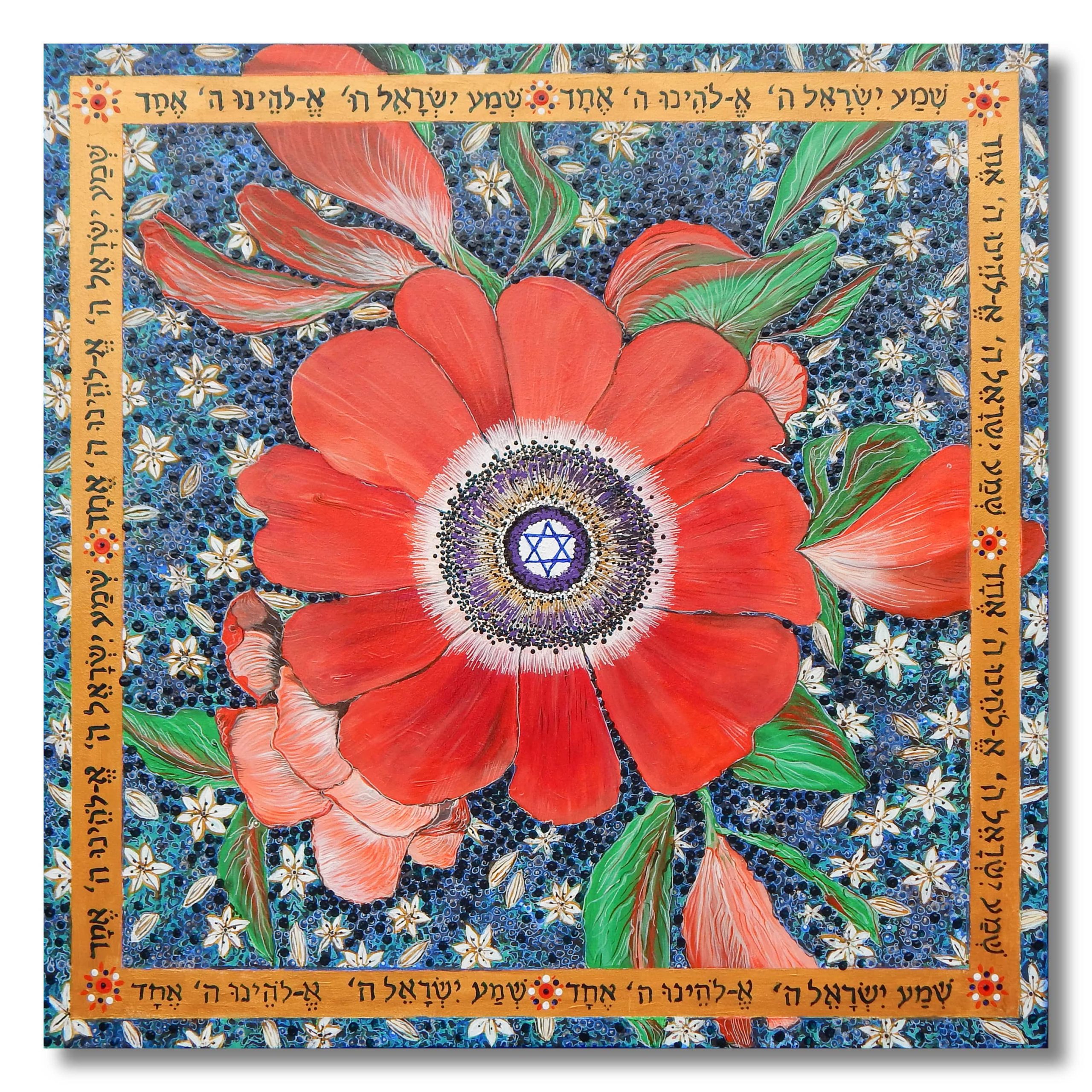
Flower: Red Poppy
Sacred Symbol: Star of David
Mantra/Prayer: Shema Prayer Hear, O Israel, the Lord is our God, the Lord alone!
Flower:
In the Torah, namely the first five books of the Hebrew Bible
attributed to Moses, flowers are mentioned in the context of the
Tabernacle, which was the principal place of worship during the forty
years’ wandering in the Sinai desert, and of the great Temple built by
Solomon in Jerusalem. These sacred spaces were adorned with intricate
floral motifs and decorations, symbolizing the divine presence and
creating a visually awe-inspiring atmosphere. Flowers in these sacred
spaces sought to evoke a sense of beauty, reverence, and connection with
the divine. The flower in this painting is a poppy, a universal symbol of remembrance,
hope, and resilience. For Jewish people this flower also represents
survival. On the Feast of Purim, which commemorates the saving of their
community from annihilation at a point of time during Persian rule as well
as throughout the centuries, many Jews around the world enjoy poppy
seed desserts
Sacred Symbol:
The sacred symbol in the middle of the painting is ‘The
Star of David’, a six-pointed star made up of two equilateral triangles
superimposed over each other. It is recognised as the symbol of the chosen people and is named after
David, the great king of ancient Israel. In Hebrew it’s known as the ‘Shield
of David’ (Magen David). Jews started to use this symbol more prominently
during the Middle Ages The establishment of Israel in 1948 and the use of the Star of David in
the Israeli flag has strengthened the association of the Star of David with
the Jewish people. It is now the most universally recognisable symbol of
Judaism and the Jewish people around the world.
Mantra/Prayer:
The words in Hebrew script surrounding the flower
constitute the first verse of an all-important Jewish text known as the
Shema: “Hear, O Israel, the Lord is our God, the Lord alone!” This verse encapsulates the monotheistic essence of Judaism and is
traditionally recited twice a day, as part of the morning and evening
prayer services.