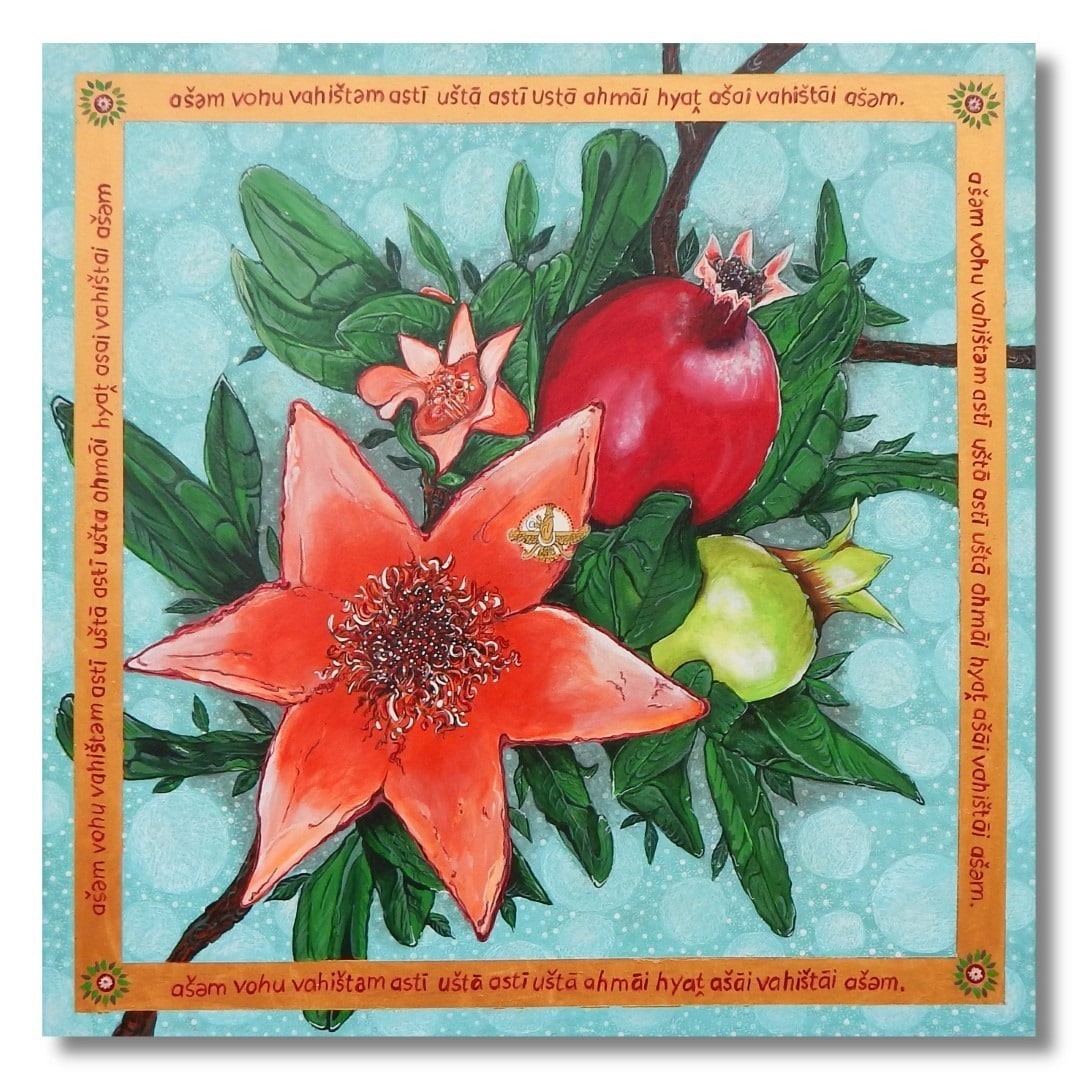
"Do not do to others what is harmful for yourself" Shayast-na-Shayast 13, 29
Flower: Pomegranate
Sacred Symbol: Faravahar
Mantra/Prayer: Ashem Vohu
Flower:
In the Zoroastrian tradition, the pomegranate plant, being
evergreen throughout the year, symbolizes the soul’s immortality and the
perfection of nature. Because of its many seeds, in Persian culture it is also
regarded as a symbol of fertility and prosperity The pomegranate is used in many rituals including the Yasna, the central
ritual of Zoroastrianism. The Yasna imparts blessings on a living or
departed person whilst maintaining cosmic integrity. The ritual has as its
focus the preparation and consumption of the sacred drink of immortality
called haoma pressed from the haoma plant. This juice is offered to the
deities together with milk and pomegranate (in the form of fruit, leaves
and/or tree twigs): “If we have offended thee, let this oblation compensate
thee with its haoma, its milk and its pomegranate.” Avesta, Yasna 68:1
Sacred Symbol:
The sacred symbol in the middle of the painting is the
Faravahar. Although there is no universal consensus on what it means,
one interpretation divides the image into six parts: (i) First part is the elderly man, symbolising the human soul and the wisdom
of age; (ii) The second part shows his hands. One hand points upwards, symbolic
of choosing the right path. In the other hand is a ring, representing
faithfulness and loyalty to the teachings of Zoroaster; (iii) The third part is the ring from which the man emerges, representing
either the eternal nature of the universe, or the immortality of the soul; (iv) The fourth part shows the wings, which have three layers representing
the three principles of Zoroaster, good thoughts, good words, and good
deeds; (v) The fifth part, the feathers of the tail, represents what should be
avoided, bad thoughts, bad words, and bad deeds; (vi) Lastly, the two streamers coming out of the ring represent positive and
negative forces, indicating one should choose good over evil.
Mantra/Prayer:
The words surrounding the flower are from the Ashem
Vohu prayer. It is dedicated to Asha, a Zoroastrian concept denoting truth,
order or righteousness, that is promoted and embodied by Ahura Mazda
who is the creator deity and God of the sky. There are many translations,
one of which is: ‘Holiness (Asha) is the best of all good: it is also happiness.
Happy the man who is holy with perfect holiness!’