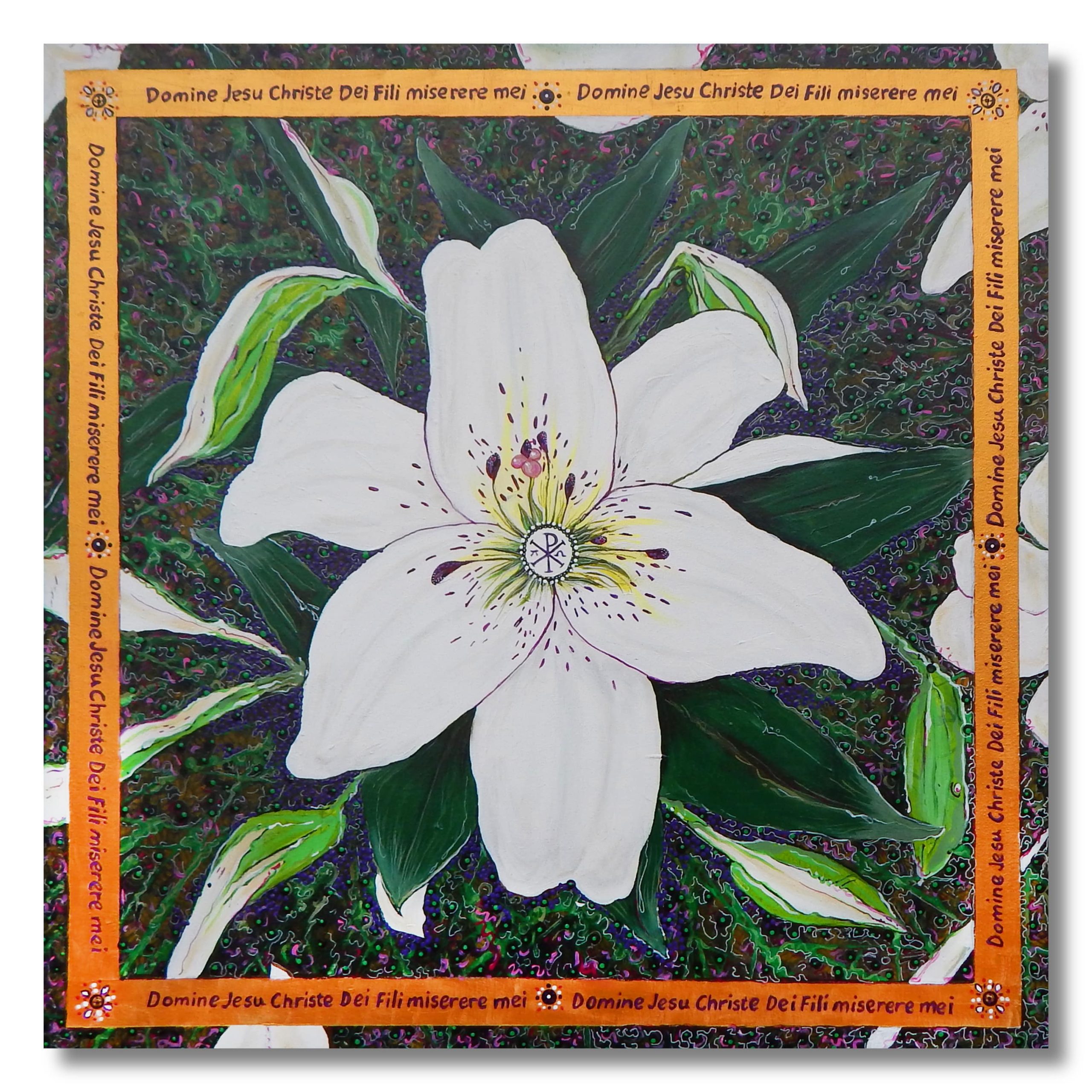
"In everything, do to others as you would have them do to you; for this is the law and the prophets." Gospel of St Matthew 7:12
Flower: White Easter Lily
Sacred Symbol: Chi-Rho
Mantra/Prayer: The Jesus Prayer Domine Jesu Christe Dei Fili miserere me (Lord Jesus Christ, Son of God, have mercy on me)
Flower:
In the Bible, flowers are sometimes used as metaphors to convey
profound spiritual truths. One such flower is the lily which carries deep
symbolic significance. “So why do you worry about clothing? Consider the lilies of the field, how they
grow: they neither toil nor spin; and yet I say to you that even Solomon in all
his glory was not arrayed like one of these.... So do not worry.” Gospel of St.
Matthew 6:28-31 Lilies are often associated with hope and rebirth. Since these flowers
bloom after a long winter, they represent the promise of unlimited and
eternal life. The colour white is above all symbolic of the glorious resurrection of Christ
Jesus whose victory over sin and death is celebrated at Easter. During the
Middle Ages, the white lily was closely associated with the Virgin Mary,
Mother of Jesus, Mother of God, as a symbol of her purity. It is often
included in her portraits and has become her typical symbol.
Sacred Symbol:
The sacred symbol in the middle of the painting is ChiRho. This is an extremely ancient symbol within the Christian Church,
being found in catacombs of the second century CE. It consists of the
superimposed Greek letters chi (X) and rho (P), which are the first two
letters of the Greek word for ‘Christ’ which means ‘The Anointed One’ The symbol also includes the letters alpha (A) and omega (Ω), the first and
last of the Greek alphabet, signifying Christ who is at the beginning and
end of time.
Mantra/Prayer:
Surrounding the lily are the Latin words Domine Jesu
Christe Dei Fili miserere mei, translating to ‘Lord Jesus Christ, Son of God,
have mercy on me’. This ‘Jesus Prayer’ is a short invocation, highly esteemed in Eastern
Christianity and Catholicism. Repeated in association with the breath,
it joins the reciter in loving union with Christ Jesus, and so with the
everlasting God who sent him.