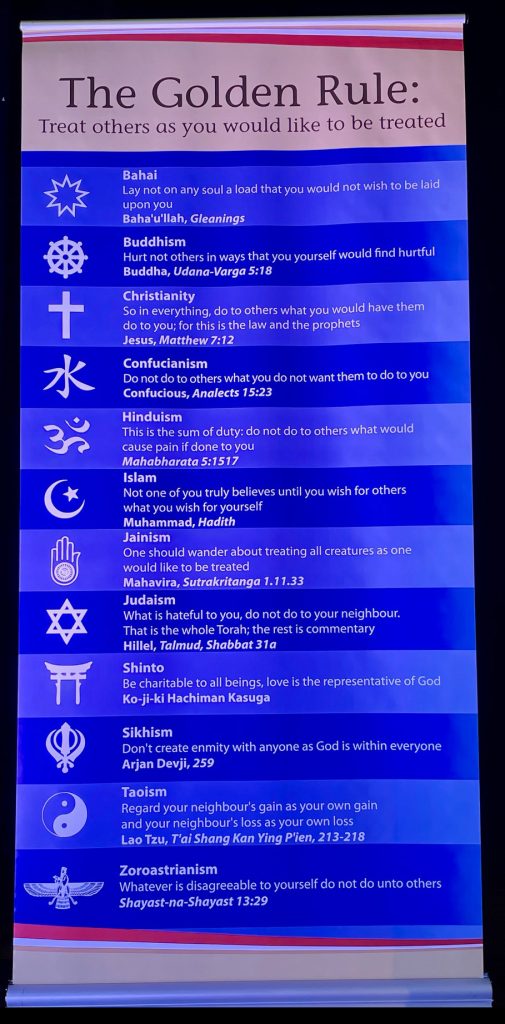
The Golden Rule is the principle of treating others as we ourselves would wish to be treated. Often referred to as the ethics of reciprocity, it encourages mutual respect and empathy by urging us to extend to others the same kindness and consideration we hope to receive.
This timeless principle appears in the teachings of most religions and philosophies throughout history, making it one of the most widely shared ethical concepts across cultures. Because of its deep and recurring presence in human thought, the Golden Rule is often regarded as a universal moral standard.
Reflecting on the Golden Rule is an invitation to engage with the wisdom of humanity as a whole. It serves not only as a guide for personal conduct but also as a powerful ideal for how we relate across boundaries – between individuals, communities, cultures, nations, and belief systems.
Rooted in diverse religious and cultural traditions, the Golden Rule offers a shared ethical foundation to which people of different backgrounds can appeal when seeking to resolve conflict or build mutual understanding.
As our world becomes increasingly interconnected, the need for such a unifying principle grows ever more urgent. The Golden Rule holds the potential to serve as an ethical cornerstone in the pursuit of a more peaceful, just, and sustainable global society.
In celebration of this universal principle, the Flowers of Faith multifaith art exhibition includes reflections on what the Golden Rule means within each major world religion – and how it calls us all to treat one another with dignity and compassion.
Click on each religion to learn more about its Golden Rule, which will appear at the top of the page: Baha’i, Buddhism, Christianity, Confucianism, Hinduism, Islam, Jainism, Judaism, Shinto, Sikhism, Taoism, and Zoroastrianism.